
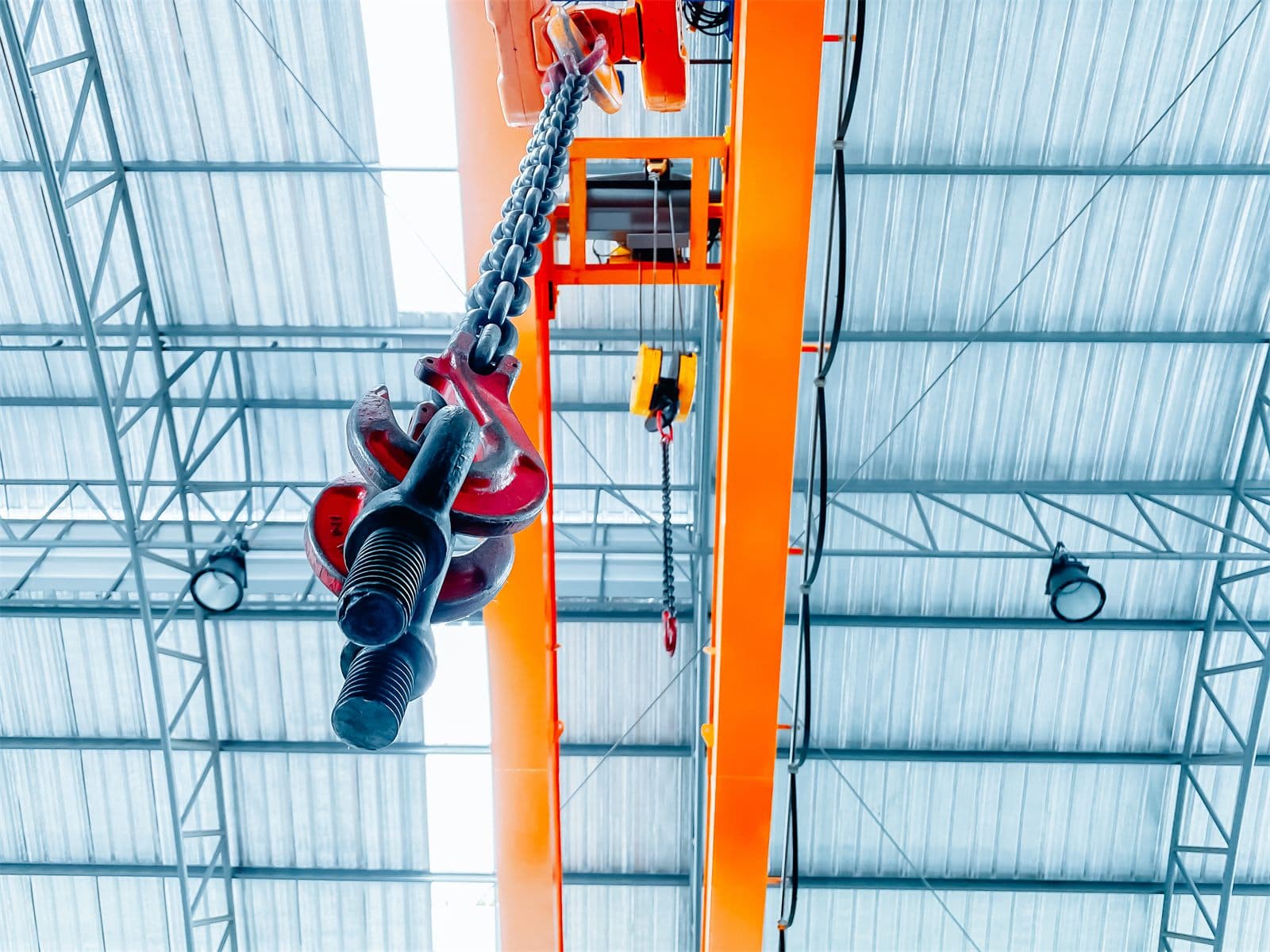
Cranes & crane systems
Spec your crane
Bridge, gantry, jib, monorail, or workstation. Tell us the load, the span, and the building, and our application engineer starts from real numbers instead of a blank page.
Crane types
Which one you need depends on the building
Capacity is rarely the deciding factor. Headroom, existing steel, and how often you lift usually settle it.
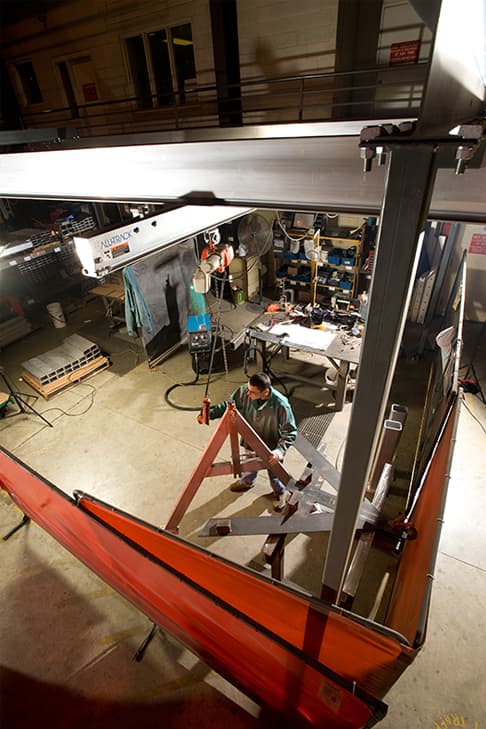
Workstation bridge crane
Enclosed track, light loads, moved by hand all day
An enclosed-track bridge running on its own structure or hung from the roof. Light enough that one person can move a load smoothly by hand, which is exactly why they get used constantly on assembly and repair work.
Best for
- Repetitive lifts on an assembly or repair line
- Operators positioning loads precisely by hand
- Covering a defined work cell rather than a whole bay
Worth knowing: Capacity is limited compared with a structural bridge crane. If loads are growing, size the runway for the future, not for today.
- Typical capacity
- 150 lb – 4,000 lb
- Typical span
- Up to about 34 ft
- Built by
- Spanco, HSI
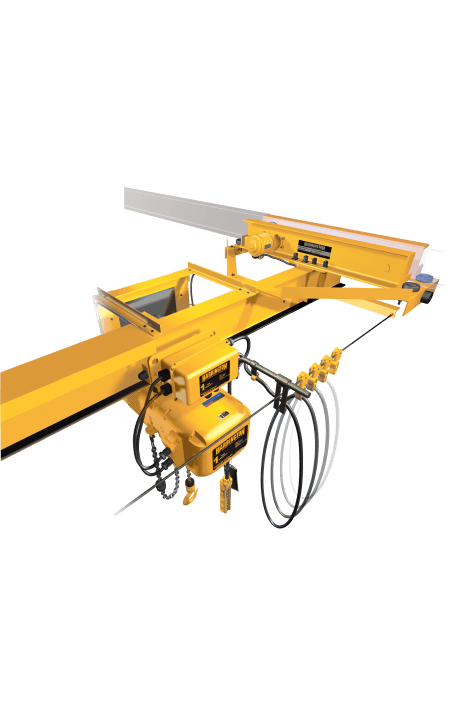
Single girder under running bridge crane
Bridge runs beneath the runway beams
The bridge end trucks ride on the bottom flange of the runway beams. That lets the runway sit on existing building steel in many cases, and it gets the hook closer to the walls than a top running crane.
Best for
- Buildings where the runway can hang from existing roof steel
- Getting good hook coverage close to the side walls
- Light to moderate duty in an existing building
Worth knowing: Your building steel has to accept the load. That's an engineering question before it's a purchasing one — we'll want drawings.
- Typical capacity
- 1/2 – 15 ton
- Typical span
- Up to about 60 ft
- Built by
- UESCO, Harrington
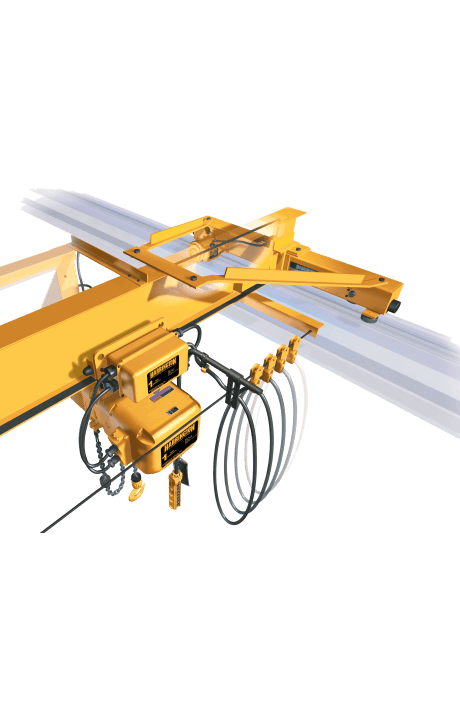
Single girder top running bridge crane
Bridge rides on rails above the runway beams
The most common industrial bridge crane. End trucks run on rails on top of the runway beams, carried by the building columns or a free-standing structure. More capacity and span than under running for the same money.
Best for
- General plant and production lifting
- New buildings, or existing ones with adequate columns
- Better hook height than under running in the same building
Worth knowing: Needs a proper runway and column support. If the building wasn't designed for a crane, budget for the structure as well as the crane.
- Typical capacity
- 1 – 25 ton
- Typical span
- Up to about 90 ft
- Built by
- UESCO, Harrington
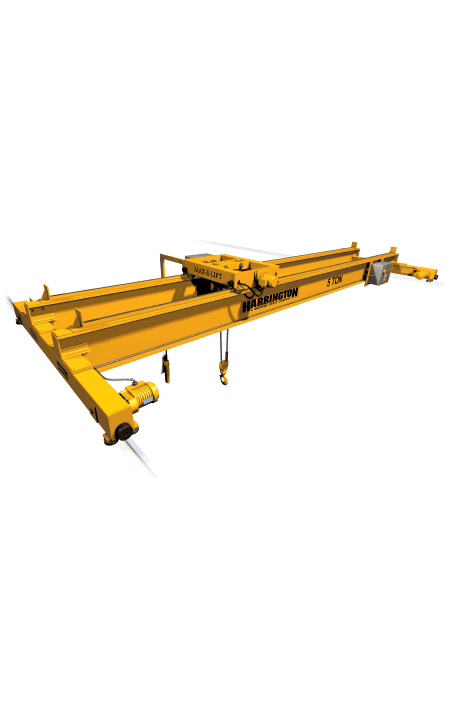
Double girder top running bridge crane
Two girders, maximum hook height and capacity
Two bridge girders with the trolley running on rails on top. It buys you the highest hook height in a given building and handles the heaviest loads, longest spans, and hardest duty cycles.
Best for
- Heavy loads, long spans, or severe duty
- Getting the hook as high as the building allows
- Carrying walkways, magnets, or other equipment on the bridge
Worth knowing: Heavier and more expensive than single girder. Worth it above roughly 15 tons or where hook height is the binding constraint.
- Typical capacity
- 5 – 100+ ton
- Typical span
- Up to about 120 ft
- Built by
- UESCO, Harrington
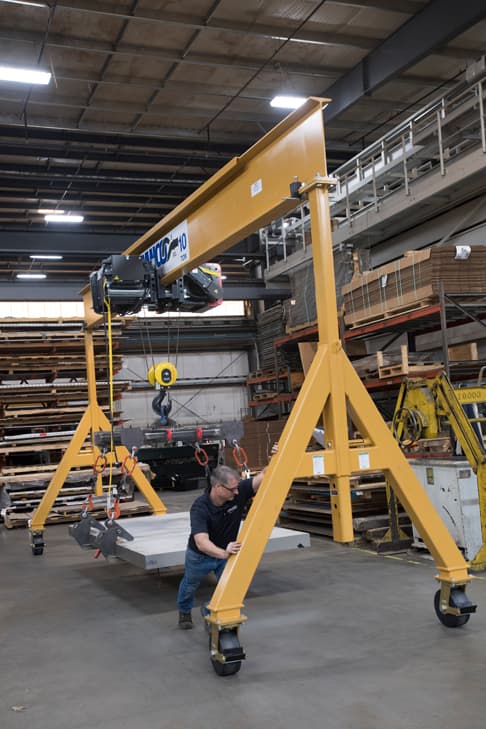
Gantry crane
Brings its own legs — no runway, no building steel
A bridge on legs that rolls on the floor or on rails. Portable aluminium units for maintenance work, right through to heavy motorised steel gantries. The answer when you can't or don't want to touch the building.
Best for
- Leased buildings, or structures that can't carry a crane
- Work that moves between bays or outdoors
- Maintenance and one-off lifts where a fixed crane isn't justified
Worth knowing: Floor condition matters more than people expect. Adjustable-height models trade some capacity for flexibility.
- Typical capacity
- 1/2 – 15 ton
- Typical span
- Up to about 30 ft
- Built by
- Spanco, HSI, UESCO
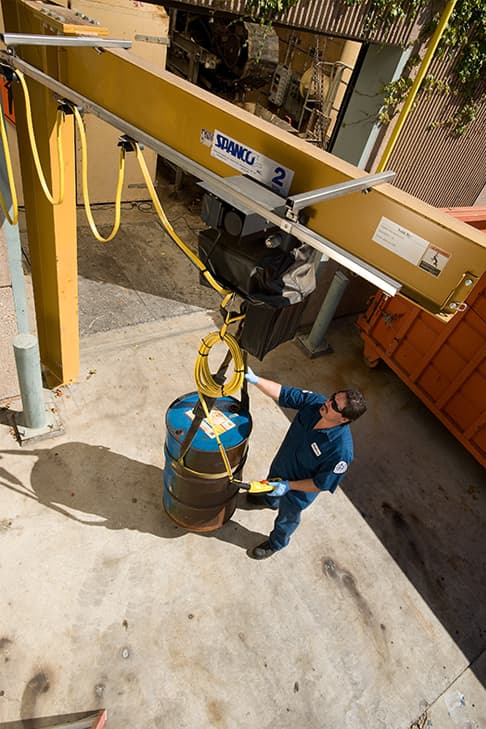
Jib crane
A boom that covers one work area completely
A rotating boom on a mast or wall column, covering a circle or arc around a single station. Free-standing, mast type, wall mounted, articulating, or telescopic — the range here is wide and the right one depends on your headroom and obstructions.
Best for
- Machine loading and unloading
- Covering one station without a full bridge system
- Working under an existing bridge crane as a secondary lift
Worth knowing: Free-standing jibs need a proper foundation — often more concrete than people budget for. Articulating booms reach around obstructions a straight boom can't.
- Typical capacity
- 250 lb – 15 ton
- Typical span
- 8 – 20 ft boom
- Built by
- Spanco, HSI
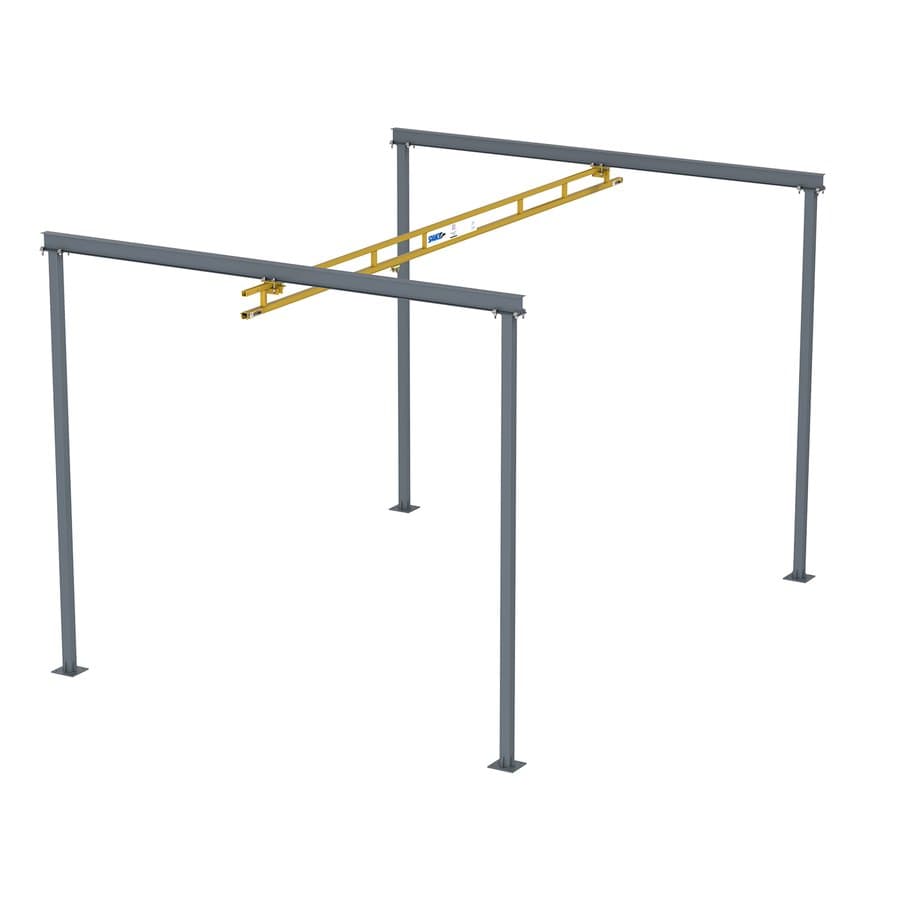
Monorail system
A fixed path, run over and over
A single fixed beam with a hoist trolley running along it. No bridge, no span — just a defined route. Ideal where the load always travels the same line, and considerably cheaper than a bridge crane for that job.
Best for
- Moving parts along a fixed production route
- Feeding a process line or between two fixed points
- Curves, switches, and drops where a bridge crane can't go
Worth knowing: Only covers the line it's on. If the work moves sideways later, you'll want a bridge crane instead.
- Typical capacity
- 1/2 – 10 ton
- Typical span
- Any length
- Built by
- UESCO, Spanco, HSI
Who builds them
Three manufacturers, chosen for different jobs
We're not tied to one line. The right manufacturer depends on whether you need a built-to-order structural crane or a catalogue jib that ships next week.
UESCO
Built-to-order overhead bridge cranes — single and double girder, top running and under running. Where the crane has to fit the building rather than the other way round.
Spanco
Jib, gantry, workstation, and monorail systems. Strong on the lighter, repeatable lifts that happen hundreds of times a shift.
Harrington
Bridge crane kits and complete systems — top running, underhung, and double girder — alongside the hoist line we already stock and service.
HSI
Deep jib and gantry range, including articulating and telescopic booms, plus enclosed track and free-standing bridge systems.
Beyond the purchase
A crane is a thirty year decision
The buying decision takes weeks. Living with it takes decades — which is why we'd rather sell you the right one and then keep it running.
- We inspect and repair every brand, not only what we sell
- OSHA-required periodic inspections with written deficiency reports
- Capacity upgrades, radio conversions, and relocations on existing cranes
- Operator and rigger training on your equipment, in your building
- Runway survey and alignment before problems become failures
- Wire rope, chain, brakes, and contactors kept in stock
Not sure what you need?
Most crane conversations start with someone describing a problem, not a product. Tell us what you're lifting and we'll walk the building with you.