
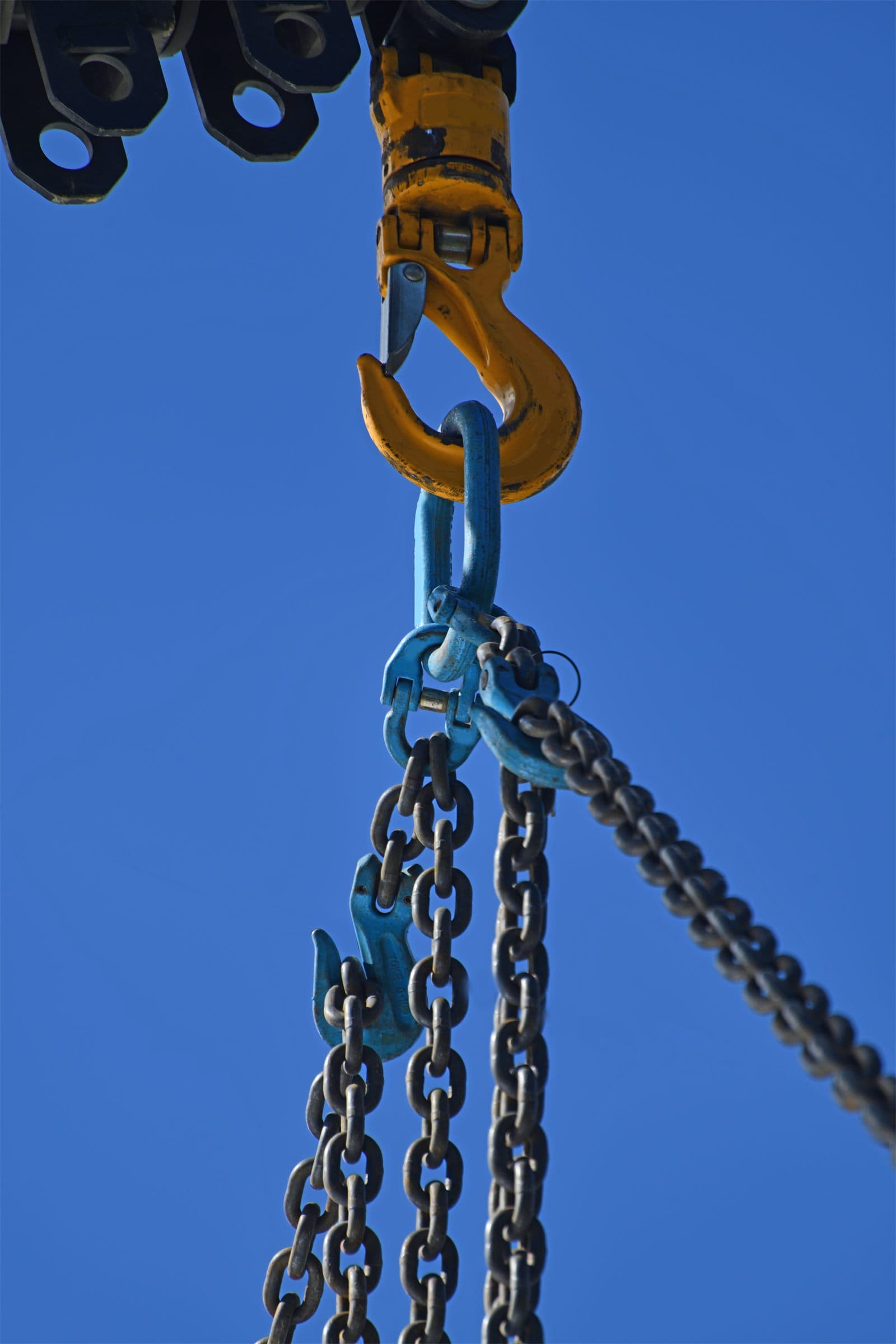
Lifting slings
Web sling bridles
Two, three, and four leg assemblies with an oblong master link top and your choice of end fitting. Configure it and get the part number plus rated capacity at each sling angle.
Build your bridle
Legs, fittings, length
Every bridle is made to order. Pick the configuration and we'll build it, tag it, and ship it with the rating documented.
Sling angle
The angle costs you more than people expect
A bridle's rating depends on the horizontal angle of the legs. Shallower legs put far more tension in each leg than the load weight alone suggests.
| Horizontal angle | You keep | Practical effect |
|---|---|---|
| 90° | 100% | Legs straight up — best case |
| 60° | 86% | Common, comfortable rigging angle |
| 45° | 71% | Getting shallow — check your rating |
| 30° | 50% | Half your capacity is gone |
Below 30° we won’t rate a bridle at all — the leg tension climbs fast enough that it needs to be engineered, not looked up.
End fittings
Why the fitting matters as much as the web
O — Oblong master link
The standard top fitting — all legs gather into one link that drops over the hook. Also used at the bottom when the legs attach to shackles.
S — Sling (eye) hook
Latched hook on the leg end. Fastest to connect, and the usual choice for bottom fittings on a bridle.
E — Plain web eye
No hardware — just the sewn eye. Lightest and cheapest, and it won't mar a finished surface, but you need something to hook to.
The fitting can be the weak link. A bare 2-ply 1″ sling is rated 3,200 lbs vertical, but the same webbing in a bridle is rated 3,000 lbs — because the hardware, not the web, governs. That’s why bridles have their own rating table instead of reusing the sling chart.
Reading the part number
Every bridle number describes itself
Three letters for the configuration, then the leg webbing, then the length.
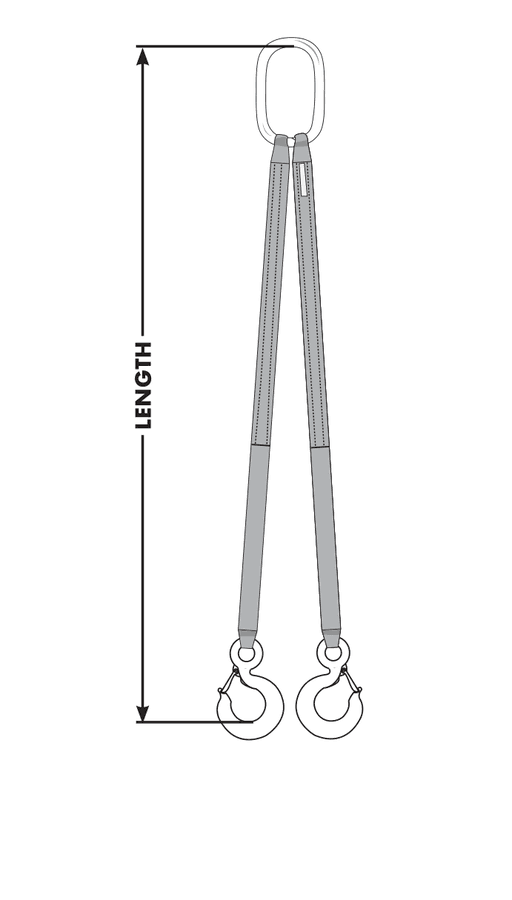
DOS-EE291x06
- D
- Double leg
- S single · D double · T triple · Q quad
- O
- Oblong master link on top
- The fitting that meets the crane hook
- S
- Sling hook on each leg end
- O master link · S sling hook · E plain eye
- EE291x06
- 2-ply 1″ legs, 6 ft
- Leg webbing code and length in feet
13 standard configurations. Anything outside them — reversed eye legs, wide body, chain or wire rope legs, mixed leg lengths — we build to order.
Before you rig
A bridle is only as good as its worst leg
Multi-leg assemblies hide problems — an uneven load can put almost everything into two legs of a four-leg bridle.
- Never assume a 4-leg bridle shares load evenly — unless the load is rigid and level, two legs may carry it
- Measure the actual horizontal angle; estimating it is where people get hurt
- All legs must be the same length unless the assembly was built for an off-centre load
- Check the master link and hooks at every inspection, not just the webbing
- Never shorten a leg by knotting or twisting it
- The capacity on the tag is the authority — not this page
The rest of the range
Other lifting slings
Need a bridle we can't configure here?
Chain and wire rope legs, mixed lengths, adjustable legs, custom fittings — most of what we ship is built to a print. Tell us the lift.