

Wire rope
Wire rope slings
Flemish-rolled eyes, IWRC core, EIPS strength — swaged and proof tested in our own shop. Configure it and get the rated capacity.
Build your sling
Construction, legs, diameter, hitch, length
Wire rope is the biggest thing we make. Every sling is built to your length, tagged, and proof tested before it ships.
Constructions
Six ways we build a wire rope sling
The Flemish-rolled eye covers most work. The rest exist because some jobs need flexibility, a wider bearing surface, or no eyes at all.
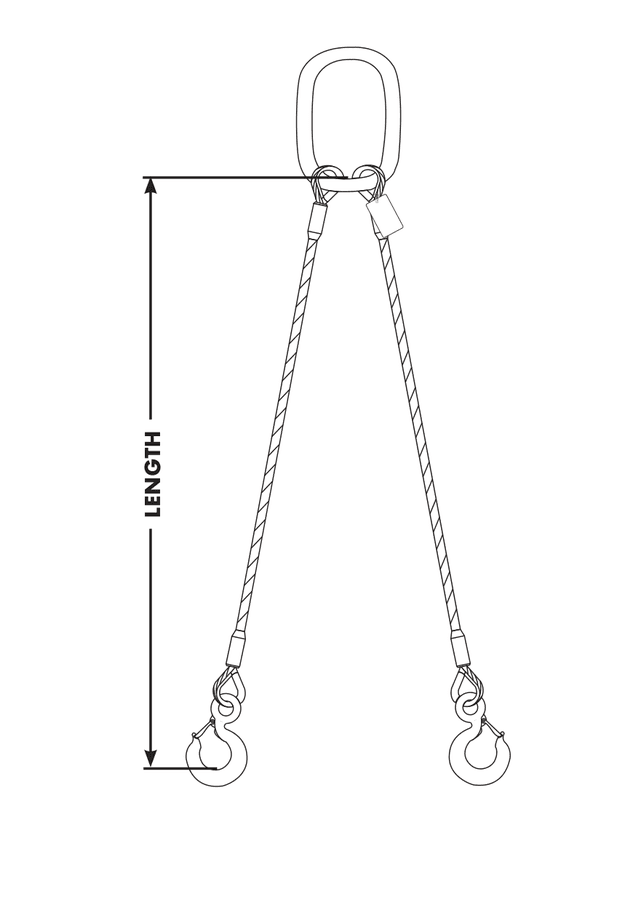
Flemish-rolled eye
The standard mechanically spliced sling. Strands are unlaid and re-rolled into the eye, then the sleeve is swaged. Strongest and most common.
Hand spliced
Hidden tuck rigger sling. More flexible than a mechanical splice, favoured for choking and where the sling must conform to the load.
Cable laid
Multiple ropes laid together. Very flexible with good resistance to kinking, used where a sling gets handled hard.
6-part braided
Six ropes braided into a flat, wide body. Excellent flexibility and a broad bearing surface on the load.
8-part braided
Eight ropes braided, for the heaviest flexible slings. Spreads load over the widest surface of any wire rope sling.
Endless grommet
A continuous loop with no eyes, specified by circumferential length. Wear can be rotated around the body.
End fittings and terminations
- Standard eye
- Thimble eye
- Eye sling hook with latch
- Swivel hook with latch
- Positive latching hook
- Sliding choker hook
- Oblong master link
- Oblong master link with sub-assembly
- Screw pin shackle
- Threaded stud
- Button stop
- Closed and open swage socket
- Closed and open spelter socket
- Wedge socket
- Concrete pipe lifting fixture
Capacity
Rated capacities, published
Working load limits in tons, to ASME B30.9, for Flemish-rolled eye slings with IWRC core and EIPS strength. Basket figures assume a D/d ratio of 25:1 — a smaller pin reduces them.
1 leg
| Rope size | Vertical | Choker | Basket 90° | Basket 60° | Basket 45° | Basket 30° | Eye size |
|---|---|---|---|---|---|---|---|
| 1/4″ | 0.65 | 0.48 | 1.3 | 1.1 | 0.91 | 0.65 | 2 x 4″ |
| 5/16″ | 1 | 0.74 | 2 | 1.7 | 1.4 | 1 | 2-1/2 x 5″ |
| 3/8″ | 1.4 | 1.1 | 2.9 | 2.5 | 2 | 1.4 | 3 x 6″ |
| 1/2″ | 2.5 | 1.9 | 5.1 | 4.4 | 3.6 | 2.5 | 4 x 8″ |
| 5/8″ | 3.9 | 2.9 | 7.8 | 6.8 | 5.5 | 3.9 | 5 x 10″ |
| 3/4″ | 5.6 | 4.1 | 11 | 9.7 | 7.9 | 5.6 | 6 x 12″ |
| 7/8″ | 7.6 | 5.6 | 15 | 13 | 11 | 7.6 | 7 x 14″ |
| 1″ | 9.8 | 7.2 | 20 | 17 | 14 | 9.8 | 8 x 16″ |
| 1-1/8″ | 12 | 9.1 | 24 | 21 | 17 | 12 | 9 x 18″ |
| 1-1/4″ | 15 | 11 | 30 | 26 | 21 | 15 | 10 x 20″ |
| 1-3/8″ | 18 | 13 | 36 | 31 | 25 | 18 | 11 x 22″ |
| 1-1/2″ | 21 | 16 | 42 | 37 | 30 | 21 | 12 x 24″ |
| 1-3/4″ | 28 | 21 | 57 | 49 | 40 | 28 | 14 x 28″ |
| 2″ | 37 | 28 | 73 | 63 | 52 | 37 | 16 x 32″ |
2 leg
| Rope size | 60° | 45° | 30° | Master link | Hook capacity |
|---|---|---|---|---|---|
| 1/4″ | 1.1 | 0.91 | 0.65 | 1/2″ | 1 t |
| 5/16″ | 1.7 | 1.4 | 1 | 3/4″ | 2 t |
| 3/8″ | 2.5 | 2 | 1.4 | 3/4″ | 2 t |
| 1/2″ | 4.4 | 3.6 | 2.5 | 1″ | 3 t |
| 5/8″ | 6.8 | 5.5 | 3.9 | 1″ | 5 t |
| 3/4″ | 9.7 | 7.9 | 5.6 | 1-1/4″ | 7 t |
| 7/8″ | 13 | 11 | 7.6 | 1-1/2″ | 11 t |
| 1″ | 17 | 14 | 9.8 | 1-1/2″ | 11 t |
| 1-1/8″ | 21 | 17 | 12 | 1-1/2″ | 15 t |
| 1-1/4″ | 26 | 21 | 15 | 1-3/4″ | 15 t |
| 1-3/8″ | 31 | 25 | 18 | 2″ | 22 t |
| 1-1/2″ | 37 | 30 | 21 | 2-1/4″ | 22 t |
3 leg
| Rope size | 60° | 45° | 30° | Master link | Hook capacity |
|---|---|---|---|---|---|
| 1/4″ | 1.7 | 1.4 | 0.97 | 3/4″ | 1 t |
| 5/16″ | 2.6 | 2.1 | 1.5 | 3/4″ | 2 t |
| 3/8″ | 3.7 | 3 | 2.2 | 3/4″ | 2 t |
| 1/2″ | 6.6 | 5.4 | 3.8 | 1″ | 3 t |
| 5/8″ | 10 | 8.3 | 5.9 | 1-1/4″ | 5 t |
| 3/4″ | 15 | 12 | 8.4 | 1-1/2″ | 7 t |
| 7/8″ | 20 | 16 | 11 | 1-1/2″ | 11 t |
| 1″ | 26 | 21 | 15 | 1-3/4″ | 11 t |
| 1-1/8″ | 31 | 26 | 18 | 2″ | 15 t |
| 1-1/4″ | 38 | 31 | 22 | 2-1/4″ | 15 t |
| 1-3/8″ | 46 | 38 | 27 | 2-1/2″ | 22 t |
| 1-1/2″ | 55 | 45 | 32 | 2-1/2″ | 22 t |
4 leg
| Rope size | 60° | 45° | 30° | Master link | Hook capacity |
|---|---|---|---|---|---|
| 1/4″ | 2.2 | 1.8 | 1.3 | 3/4″ | 1 t |
| 5/16″ | 3.5 | 2.8 | 2 | 3/4″ | 2 t |
| 3/8″ | 5 | 4.1 | 2.9 | 1″ | 2 t |
| 1/2″ | 8.8 | 7.1 | 5.1 | 1-1/4″ | 3 t |
| 5/8″ | 14 | 11 | 7.8 | 1-1/4″ | 5 t |
| 3/4″ | 19 | 16 | 11 | 1-1/2″ | 7 t |
| 7/8″ | 26 | 21 | 15 | 2″ | 11 t |
| 1″ | 34 | 28 | 20 | 2-1/4″ | 11 t |
| 1-1/8″ | 42 | 34 | 24 | 2-1/2″ | 15 t |
| 1-1/4″ | 51 | 42 | 30 | 2-3/4″ | 15 t |
| 1-3/8″ | 62 | 50 | 36 | 3″ | 22 t |
| 1-1/2″ | 73 | 60 | 42 | 3-1/4″ | 22 t |
Before you rig
Wire rope tells you it's failing — if you look
Broken wires, birdcaging, and core protrusion all show before a sling lets go. OSHA 1910.184 and ASME B30.9 require documented inspection by a competent person.
- Remove from service on broken wires, kinks, birdcaging, or core protrusion
- No tag, no lift — a sling without a legible tag is out of service
- Basket capacity depends on D/d — a small pin cuts it sharply
- Never let a sling bend over a sharp edge without protection
- A 4 leg wire rope sling is rated above a 3 leg, unlike chain
- We re-terminate and re-certify damaged assemblies rather than scrapping them
The rest of the range
Other lifting slings
Need something bigger, or built to a print?
Shovel cable, dragline rope, sockets poured and swaged, assemblies to 2 inch and beyond. Bring us a print, a sample, or just the problem.